Ringdown bounds on UV-regularized black-hole cores
Using the ringdown of merging black holes to bound the size of a non-singular quantum core, and the scaling-law regression framework that turns a whole catalogue of events into one test.

Listening to black holes
Black holes are the most extreme objects we know of, and that makes them the best laboratory we have for gravity. They are where general relativity is pushed hardest, and where we should expect it to break first.
The place it breaks is the centre. General relativity predicts a singularity — a point of infinite density where the theory stops producing meaningful answers. Most approaches to quantum gravity expect something else there: a finite, non-singular core in which curvature stays bounded. A UV-regular core is exactly that, a finite-sized region replacing the classical singularity so that curvature remains bounded at Planck-scale distances.
We cannot send a probe to check. But we can listen. When two black holes merge, the remnant wobbles and rings like a struck bell, radiating gravitational waves at characteristic frequencies that decay at characteristic rates. That ringdown is the closest thing we have to a direct measurement of the object’s structure — and if the core is not a point, the ringing should be very slightly off-pitch.
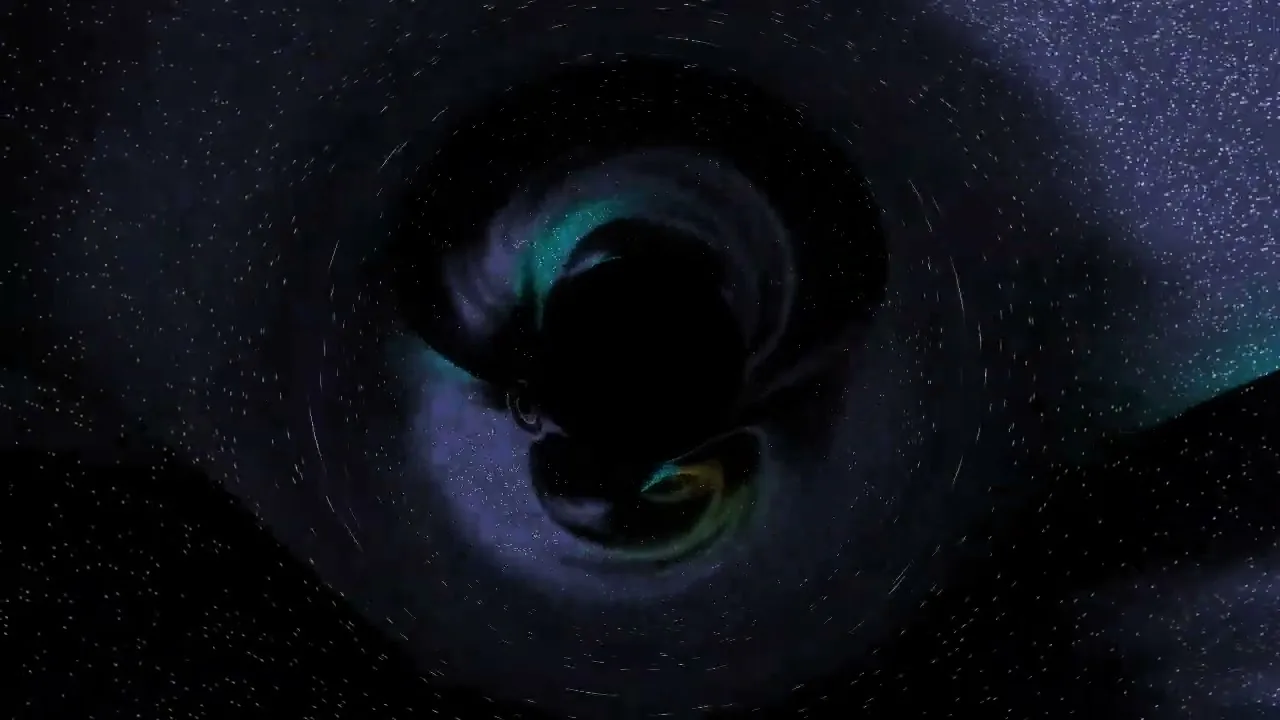
The animation above is not from the analysis; it is a visualisation I made to give a feel for the dynamics near a horizon.
Why look past the singularity
In physics an infinity is usually a symptom, not a result. It signals that a theory has been extended past the regime where it holds. The central singularity is the clearest such symptom in general relativity.
Quantum mechanics is expected to intervene before that point. Combining gravity with quantum mechanics repeatedly produces a minimum length, generally near the Planck scale — a floor below which the notion of separation stops being meaningful. If spacetime has a smallest resolvable scale rather than being smooth all the way down, matter cannot collapse to a dimensionless point, and the singularity has to be replaced by something of finite extent.
The signature of a de Sitter core
A recurring proposal is that collapsing matter undergoes a phase transition into a false-vacuum state, leaving a small patch of de Sitter space — a region whose intrinsic repulsive pressure halts the collapse and holds the core open at some size L.
We model this with a Hayward-type metric, which interpolates smoothly from an ordinary black-hole exterior to a non-singular de Sitter core of size L. The result is a clean prediction. Writing r_s for the horizon radius, the fractional shifts in ringdown frequency and damping time go as the cube of the core’s relative size:
(δf̂, δτ̂) = (c_f, c_τ) · (L/r_s)³ + O((L/r_s)⁵)That cubic response is a fingerprint, and its value is in what it excludes. Long-range modifications to the metric produce a linear response in L/r_s instead. The exponent, not just the magnitude, tells you which kind of new physics you are looking at.
Calibrating the coefficients c_f and c_τ reliably mattered more than deriving them once, so we computed them three independent ways:
- Double-null time-domain evolution — a direct simulation, used as the anchor result.
- An audited Leaver continued-fraction solver — a high-precision frequency-domain method, terminated with Nollert’s condition, used as a cross-check.
- A local WKB–Padé surrogate — fast and accurate enough to interpolate behaviour near the pure general-relativity limit.
All three agree, which is what makes the fingerprint worth testing against data.
A toolkit, not a single number
The more useful output is not one bound but a method: use an entire catalogue of gravitational-wave events at once. We call it scaling-law regression. Rather than asking whether a single event deviates from general relativity, it asks whether deviations across many events follow the specific trend a hidden core would impose.
That turns the search into a discriminator between whole classes of theory:
- Localised cores give the cubic response,
∝ (L/r_s)³. - Long-range metric tails give a linear leakage term,
∝ (L/r_s). - Propagation effects such as modified dispersion relations add mass-dependent shifts with their own dependence on the remnant’s spin.
- Exotic compact objects predict late-time echoes or phase shifts rather than a small coherent shift in the dominant mode.
The sharpest part of the test is coherence. A genuine core signal must distort frequency and damping time together, in the fixed ratio (c_f, c_τ). Projecting each event onto that predicted direction amplifies a real signal and suppresses noise that does not share it.
From theory to data
Exploiting a full catalogue needs care on the statistics, so the fits are covariance-aware, start-marginalised and hierarchical: correlated uncertainties in frequency and damping time are carried per event, and sensitivity to the choice of ringdown start time is marginalised over rather than fixed by hand.
That machinery lets two competing hypotheses about a core be tested directly against each other:
- The absolute law,
L = L₀— the core has a fixed universal size, so the deviation should scale as1/M³across the catalogue. - The fractional law,
L = ε · r_s— the core is a fixed fraction of the black hole, so the deviation should be independent of mass.
A validity prior keeps the analysis honest by restricting it to core sizes small enough for the cubic expansion to hold, and we provide a dictionary for translating the resulting bounds into the parameters of other models.
Where the AI actually helped
This was an AI-augmented project with human experts in the loop at every step, and it is worth being specific about where the leverage was:
- Literature review. A custom deep-research routine worked through decades of papers to surface connections between theoretical models and observational constraints that would have taken far longer to find by hand.
- Symbolic verification. The derivations behind the prediction are long and easy to get quietly wrong. Symbolic solvers checked the algebra and validated the numerical solver code against it.
- Analysis and iteration. Language and vision models helped triage simulation output, spot patterns and visualise relationships across a large parameter sweep.
None of that replaces the physics. It shortens the loop between having an idea and knowing whether it survives.
What’s next
The framework points at a clear set of next steps:
- Kerr calibration — extend from non-spinning to spinning remnants with a Teukolsky-based solver, mapping the spin dependence of
c_f(a)andc_τ(a). - Multi-mode catalogues — run coherence tests across several ringdown modes, such as
(2,2,0)and(3,3,0), where signal-to-noise allows. - Frequency-domain validation — cross-check with frequency-domain likelihoods and standardise how the analysis window is chosen.
- Open benchmarks — release the audited results, waveforms and covariances so scaling-law regression becomes a shared testbed.
The code is public at ExtensityAI/gr_qm.
What makes the approach worth continuing is that it converts a vague hunt for new physics into a structured regression problem that stays meaningful on noisy, individually unremarkable events; uses mass and spin trends across a catalogue to tell interior structure apart from long-range forces, which no single event can do; and leaves behind a pipeline reusable for any weak but structured deviation from general relativity.
Thanks to Alexander Morisse for many useful discussions, and for prompting several of the questions this work ended up addressing.
Read next
- Agentic AI for Scientific Discovery — the RL Bootcamp 2026 slides The 3rd International RL Bootcamp runs 16–18 September 2026 in Salzburg, free to attend. Here is the deck for my Friday talk, embedded to click through in full, plus what it argues and where the recordings land.
- Primality testing via circulant matrix eigenvalue structure A prime is exactly an integer whose circulant matrix has a minimal polynomial with two irreducible factors over the rationals. A clean characterisation, and a slow algorithm.