Research / Preprint
Ringdown Bounds on UV-Regularized Black-Hole Cores
Marius-Constantin Dinu
- Year
- 2025
- Length
- 18 pages
Abstract
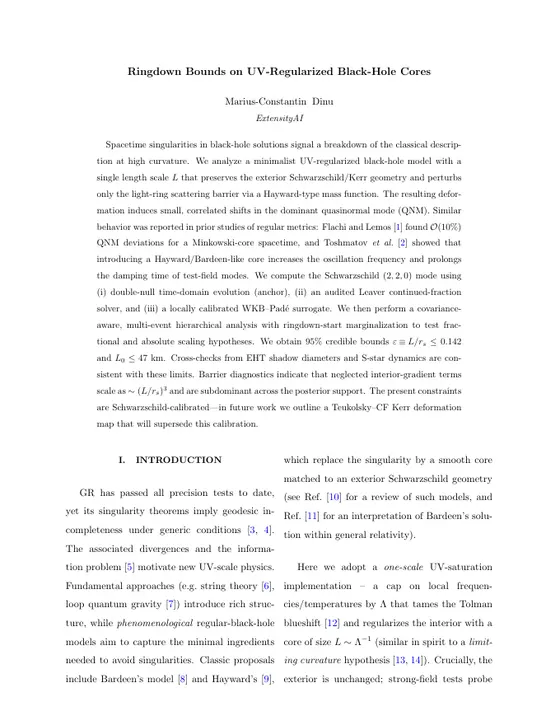
Spacetime singularities in black-hole solutions signal a breakdown of the classical description at high curvature. We analyze a minimalist UV-regularized black-hole model with a single length scale L that preserves the exterior Schwarzschild/Kerr geometry and perturbs only the light-ring scattering barrier via a Hayward-type mass function. The resulting deformation induces small, correlated shifts in the dominant quasinormal mode (QNM). Similar behavior was reported in prior studies of regular metrics: Flachi and Lemos [1] found O(10%) QNM deviations for a Minkowski-core spacetime, and Toshmatov et al. [2] showed that introducing a Hayward/Bardeen-like core increases the oscillation frequency and prolongs the damping time of test-field modes. We compute the Schwarzschild (2, 2, 0) mode using (i) double-null time-domain evolution (anchor), (ii) an audited Leaver continued-fraction solver, and (iii) a locally calibrated WKB-Pade surrogate. We then perform a covariance-aware, multi-event hierarchical analysis with ringdown-start marginalization to test fractional and absolute scaling hypotheses. We obtain 95% credible bounds e = L/rs <= 0.142 and L0 <= 47 km. Cross-checks from EHT shadow diameters and S-star dynamics are consistent with these limits. Barrier diagnostics indicate that neglected interior-gradient terms scale as (L/rs)^3 and are subdominant across the posterior support. The present constraints are Schwarzschild-calibrated - in future work we outline a Teukolsky-CF Kerr deformation map that will supersede this calibration.
Cite this paper
@techreport{dinu2025ringdown,
  author        = {Dinu, Marius-Constantin},
  title         = {Ringdown Bounds on {UV-Regularized} {Black-Hole} Cores},
  institution   = {dinu.at},
  howpublished  = {Published at https://www.dinu.at},
  year          = {2025},
  date          = {2025-09-30},
  pagetotal     = {18},
  url           = {https://www.dinu.at/research/ringdown-bounds-uv-regularized-black-hole-cores},
}
Marius-Constantin Dinu. (2025, September 30). Ringdown Bounds on UV-Regularized Black-Hole Cores. Published at https://www.dinu.at. 18 pages. https://www.dinu.at/research/ringdown-bounds-uv-regularized-black-hole-cores
TY  - RPRT
AU  - Dinu, Marius-Constantin
TI  - Ringdown Bounds on UV-Regularized Black-Hole Cores
PB  - dinu.at
PY  - 2025
DA  - 2025/09/30/
SP  - 18
UR  - https://www.dinu.at/research/ringdown-bounds-uv-regularized-black-hole-cores
N1  - Published at https://www.dinu.at
ER  -
More preprint
- Preprint · 2026 Software Commoditization in the AI-First Economy: From Implementation Moats to Contribution Markets
- Preprint · 2025 HyDRA: A Hybrid-Driven Reasoning Architecture for Verifiable Knowledge Graphs
- Preprint · 2025 Primality Testing via Circulant Matrix Eigenvalue Structure: A Novel Approach Using Cyclotomic Field Theory
- Preprint · 2024 Large Language Models Can Self-Improve At Web Agent Tasks