Announcing the SymbolicAI paper
The research paper behind SymbolicAI: a modular framework for logic-based approaches that compose generative models with solvers, plus a benchmark for evaluating LLMs in AI-centric workflows.
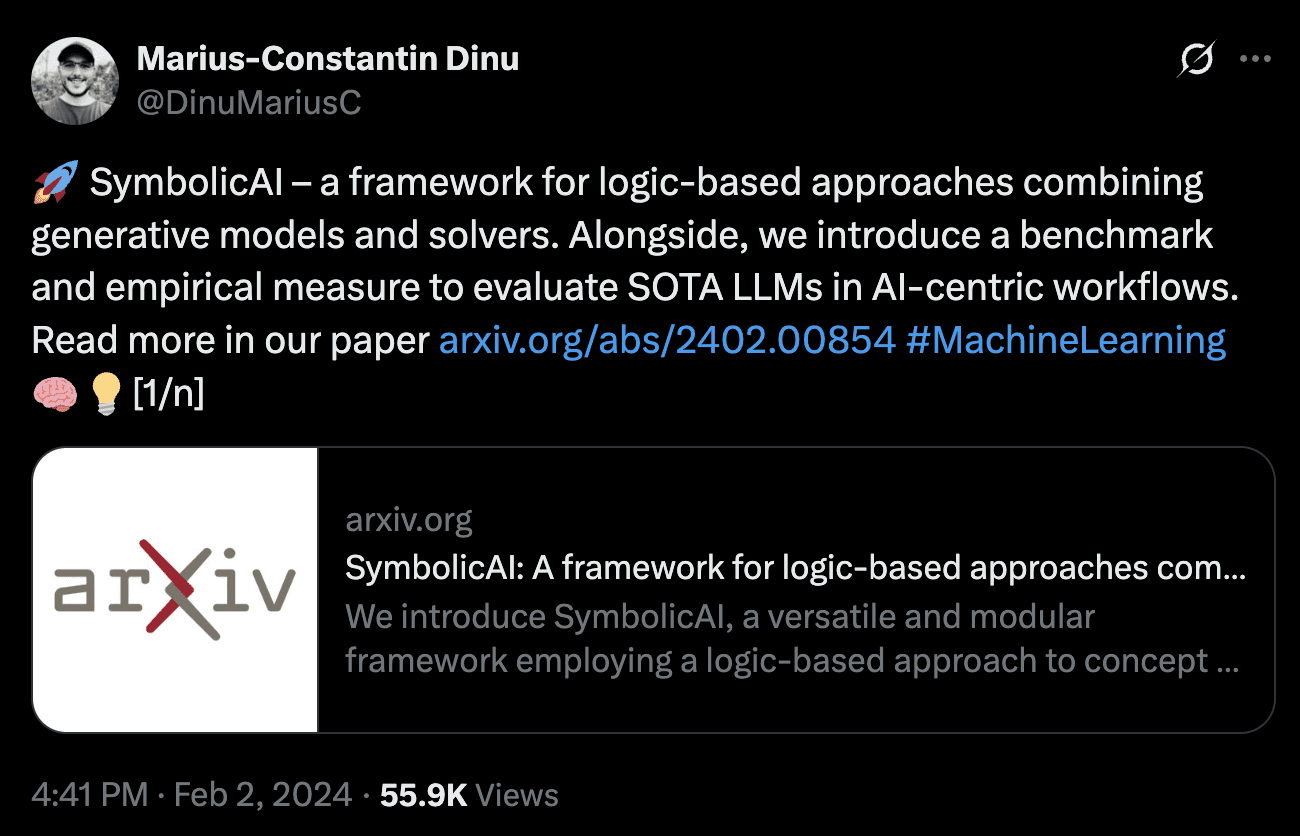
Our paper is out: SymbolicAI: A framework for logic-based approaches combining generative models and solvers. It describes the framework we have been building toward — a modular, logic-based approach to concept learning and flow management in generative models — and, alongside it, a benchmark and empirical measure for evaluating state-of-the-art language models in AI-centric workflows.
What the framework is for
The problem the paper addresses is the one that keeps recurring in applied work: deep learning is very good at recognising patterns and bad at guaranteeing anything, while symbolic systems are good at guaranteeing things and bad at dealing with the messiness of real input. Choosing between them is the wrong move. Composing them is the interesting one.
Concretely, the framework provides:
- Logic-based concept learning, so relationships between entities are represented explicitly rather than left implicit in a model’s activations.
- Flow management across generative calls, so a multi-step process stays coherent instead of drifting.
- Solver integration, handing the parts that require exact reasoning to components that can actually do it.
- A modular architecture, so the same primitives compose across domains rather than needing a bespoke pipeline each time.
The design intent is a frontend that feels familiar — closer to PyTorch than to a prompt toolkit — for composing functions in a neuro-symbolic stack.

Credit
The work was led from my Ph.D. research, with Claudiu Leoveanu-Condrei, Markus Holzleitner, Werner Zellinger and Sepp Hochreiter as co-authors — the author line the paper carries. Thanks are also due to the colleagues who argued with us along the way — Sergei Pereverzyev, Eric Squendor, Gary Marcus, Fabian Paischer, Martin Hofmann, Kevin Schweighofer, Daniel Wetzell, Clemens Wasner and Andreas Windisch.
Where this goes
The ambition is not a library that solves one class of task, but a standard for building systems that reason in checkable steps: the strengths of modern deep learning kept intact, with a structure around them that can be verified rather than trusted.
Read next
- Empowering research innovation How the neuro-symbolic stack behind SymbolicAI became a research automation platform, and what happened when we pointed it at an open question in primality testing.
- Lighter: dependency injection for PyTorch Python borrowed little from the aspect-oriented practices that matured in Java and C#. Lighter brings dependency injection to PyTorch projects.
- Deep Learning Script A DSL for Caffe that cuts the line count of prototyping a network architecture, with a VS Code extension that transpiles to Caffe Script.