Align-RUDDER: learning from few demonstrations by reward redistribution
Replacing RUDDER's LSTM with a profile model from multiple sequence alignment, so reward redistribution works from a handful of demonstrations.
Abstract
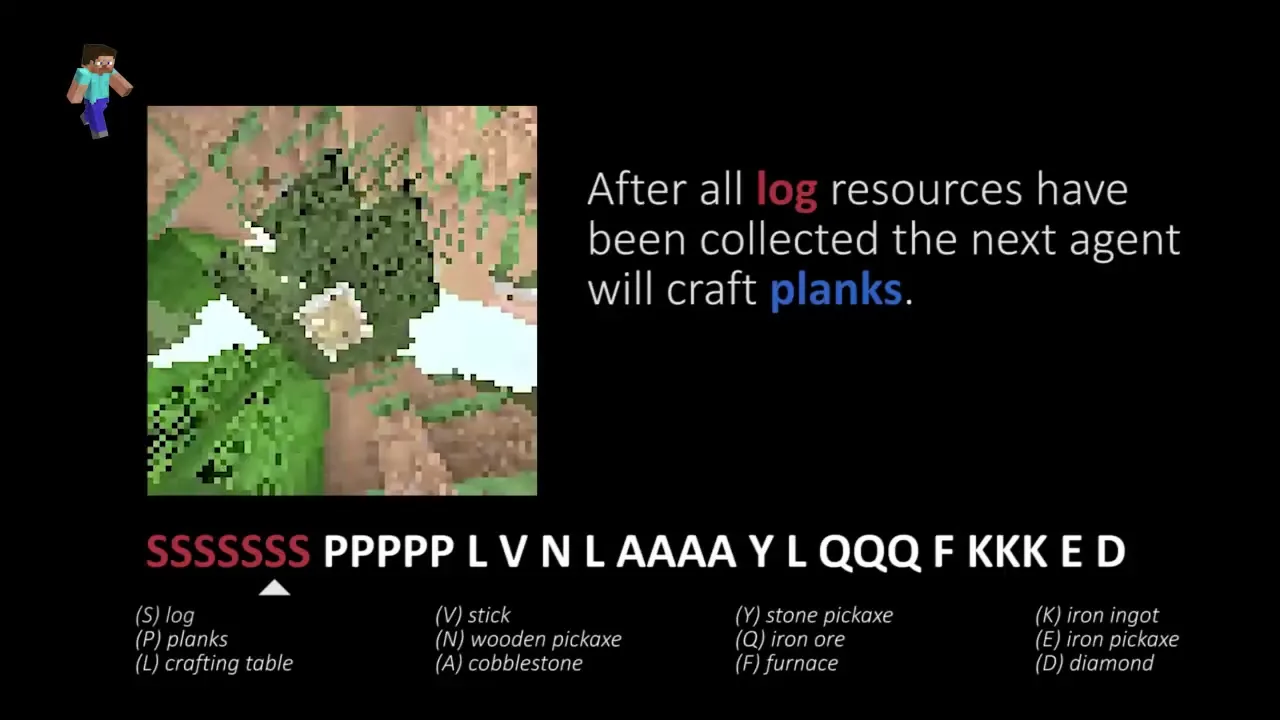
Reinforcement learning algorithms require many samples when solving complex hierarchical tasks with sparse and delayed rewards. For such complex tasks, the recently proposed RUDDER uses reward redistribution to leverage steps in the Q-function that are associated with accomplishing sub-tasks. However, often only few episodes with high rewards are available as demonstrations since current exploration strategies cannot discover them in reasonable time. In this work, we introduce Align-RUDDER, which utilizes a profile model for reward redistribution that is obtained from multiple sequence alignment of demonstrations. Consequently, Align-RUDDER employs reward redistribution effectively and, thereby, drastically improves learning on few demonstrations. Align-RUDDER outperforms competitors on complex artificial tasks with delayed rewards and few demonstrations. On the Minecraft ObtainDiamond task, Align-RUDDER is able to mine a diamond, though not frequently. Code is available at github.com/ml-jku/align-rudder.
The paper is on arXiv.
Read next
- Align-RUDDER: reward redistribution from few demonstrations The first write-up of Align-RUDDER: two modifications to RUDDER that let profile models built from as few as two demonstrations carry the reward redistribution.
- XAI and strategy extraction via reward redistribution Using Align-RUDDER as an interpretability method: multiple sequence alignment surfaces the key events an agent relies on, and those events are usually human-readable sub-tasks.
- Agentic AI for Scientific Discovery — the RL Bootcamp 2026 slides The 3rd International RL Bootcamp runs 16–18 September 2026 in Salzburg, free to attend. Here is the deck for my Friday talk, embedded to click through in full, plus what it argues and where the recordings land.