A dataset perspective on offline reinforcement learning
Two measures — SACo for exploration, TQ for exploitation — that characterise a behavioural policy's dataset and predict which offline RL algorithms will work on it.
Abstract
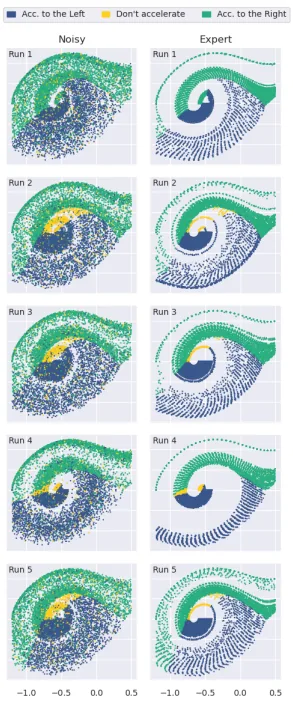
The application of Reinforcement Learning (RL) in real world environments can be expensive or risky due to sub-optimal policies during training. In Offline RL, this problem is avoided since interactions with an environment are prohibited. Policies are learned from a given dataset, which solely determines their performance. Despite this fact, how dataset characteristics influence Offline RL algorithms is still hardly investigated. The dataset characteristics are determined by the behavioral policy that samples this dataset. Therefore, we define characteristics of behavioral policies as exploratory for yielding high expected information in their interaction with the Markov Decision Process (MDP) and as exploitative for having high expected return. We implement two corresponding empirical measures for the datasets sampled by the behavioral policy in deterministic MDPs. The first empirical measure SACo is defined by the normalized unique state-action pairs and captures exploration. The second empirical measure TQ is defined by the normalized average trajectory return and captures exploitation. Empirical evaluations show the effectiveness of TQ and SACo. In large-scale experiments using our proposed measures, we show that the unconstrained off-policy Deep Q-Network family requires datasets with high SACo to find a good policy. Furthermore, experiments show that policy constraint algorithms perform well on datasets with high TQ and SACo. Finally, the experiments show, that purely dataset-constrained Behavioral Cloning performs competitively to the best Offline RL algorithms for datasets with high TQ.
The paper is on arXiv.
Read next
- Agentic AI for Scientific Discovery — the RL Bootcamp 2026 slides The 3rd International RL Bootcamp runs 16–18 September 2026 in Salzburg, free to attend. Here is the deck for my Friday talk, embedded to click through in full, plus what it argues and where the recordings land.
- Recap of the 2nd International RL Bootcamp A look back at the RL Bootcamp 2025 in Salzburg: highlights, speakers, and the recordings, slides and community links the organizers published.
- InfODist: online distillation with informative rewards Why curriculum-learning agents generalise badly to the next task, and why the culprit is the states they explore rather than the non-stationarity they endure.