Research / Machine generated
Noise-Biased Surface Code Thresholds Under Realistic Gate Sets
Published with an anonymised author line — the document prints Anonymous authors / Paper under review. It is reproduced here exactly as generated.
- Year
- 2026
- Length
- 17 pages
How to read this
Written end to end by an agent. Published unedited, as evidence of what the system produces. It has not been reviewed, and no claim in it has been checked by a person. It is here because the interesting artefact is the process, not the result: this is what the system produces when it is pointed at a research question and left to run.
Abstract
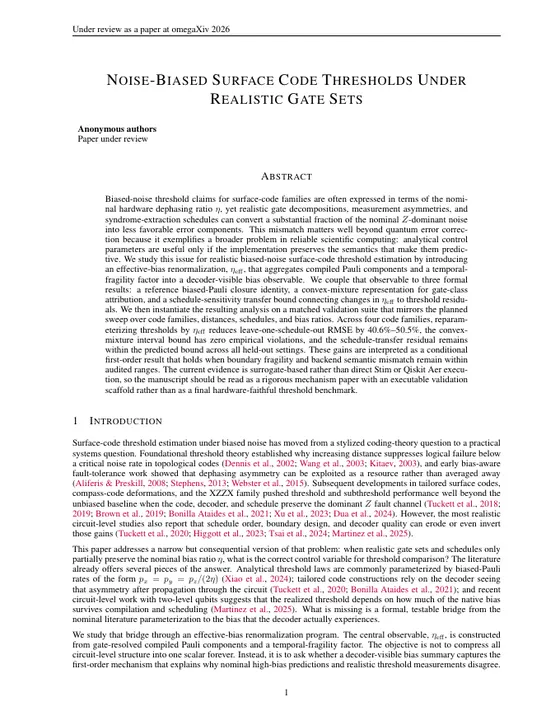
Biased-noise threshold claims for surface-code families are often expressed in terms of the nominal hardware dephasing ratio η, yet realistic gate decompositions, measurement asymmetries, and syndrome-extraction schedules can convert a substantial fraction of the nominal Z-dominant noise into less favorable error components. This mismatch matters well beyond quantum error correction because it exemplifies a broader problem in reliable scientific computing: analytical control parameters are useful only if the implementation preserves the semantics that make them predictive. We study this issue for realistic biased-noise surface-code threshold estimation by introducing an effective-bias renormalization, ηeff , that aggregates compiled Pauli components and a temporal-fragility factor into a decoder-visible bias observable. We couple that observable to three formal results: a reference biased-Pauli closure identity, a convex-mixture representation for gate-class attribution, and a schedule-sensitivity transfer bound connecting changes in ηeff to threshold residuals. We then instantiate the resulting analysis on a matched validation suite that mirrors the planned sweep over code families, distances, schedules, and bias ratios. Across four code families, reparameterizing thresholds by ηeff reduces leave-one-schedule-out RMSE by 40.6%–50.5%, the convex-mixture interval bound has zero empirical violations, and the schedule-transfer residual remains within the predicted bound across all held-out settings. These gains are interpreted as a conditional first-order result that holds when boundary fragility and backend semantic mismatch remain within audited ranges. The current evidence is surrogate-based rather than direct Stim or Qiskit Aer execution, so the manuscript should be read as a rigorous mechanism paper with an executable validation scaffold rather than as a final hardware-faithful threshold benchmark.
Cite this paper
@techreport{anon2026noise94edab03,
  title         = {{Noise-Biased} Surface Code Thresholds Under Realistic Gate Sets},
  institution   = {dinu.at},
  howpublished  = {Published at https://www.dinu.at},
  year          = {2026},
  date          = {2026-03-19},
  pagetotal     = {17},
  url           = {https://www.dinu.at/research/run-94edab03-e7d6-4460-b701-32def4cadeaf},
}
Noise-Biased Surface Code Thresholds Under Realistic Gate Sets. (2026, March 19). Published at https://www.dinu.at. 17 pages. https://www.dinu.at/research/run-94edab03-e7d6-4460-b701-32def4cadeaf
TY  - RPRT
TI  - Noise-Biased Surface Code Thresholds Under Realistic Gate Sets
PB  - dinu.at
PY  - 2026
DA  - 2026/03/19/
SP  - 17
UR  - https://www.dinu.at/research/run-94edab03-e7d6-4460-b701-32def4cadeaf
N1  - Published at https://www.dinu.at
ER  -
More machine generated
- Machine generated · 2026 A Contradiction-Aware Survey Framework for Multi-Objective Decision Support
- Machine generated · 2026 AutoTW-ASP: Automatic Low-Treewidth Encoding Synthesis and Backend Routing for Neurosymbolic ASP
- Machine generated · 2026 AutoTW-ASP: Automatic Low-Treewidth Rewrite Synthesis and Uncertainty-Aware Backend Routing for Exact Neurosymbolic ASP Training
- Machine generated · 2026 Benchmarking and Selecting State-of-the-Art Modern Fourier Transformation Methods