Research / Machine generated
Entropy-Aware Memory Systems for Continual Learning: Balancing Neuroplasticity and Stability Under Stochastic Workloads
Published with an anonymised author line — the document prints Anonymous authors / Paper under review. It is reproduced here exactly as generated.
- Year
- 2026
- Length
- 18 pages
How to read this
Written end to end by an agent. Published unedited, as evidence of what the system produces. It has not been reviewed, and no claim in it has been checked by a person. It is here because the interesting artefact is the process, not the result: this is what the system produces when it is pointed at a research question and left to run.
Abstract
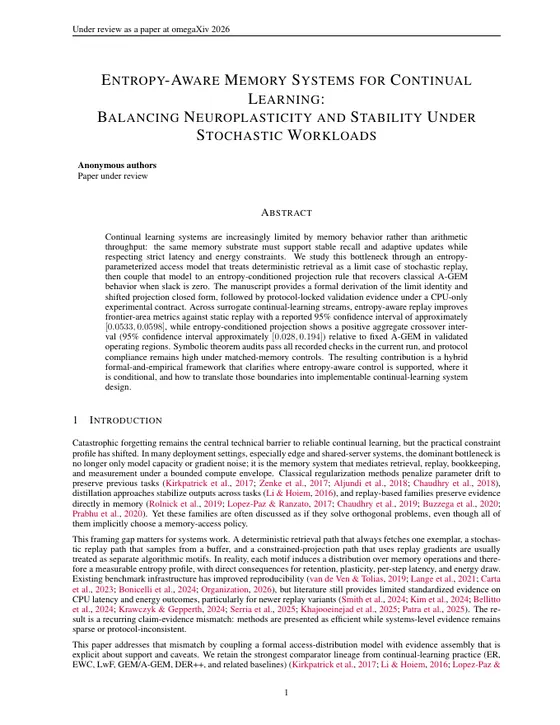
Continual learning systems are increasingly limited by memory behavior rather than arithmetic throughput: the same memory substrate must support stable recall and adaptive updates while respecting strict latency and energy constraints. We study this bottleneck through an entropy-parameterized access model that treats deterministic retrieval as a limit case of stochastic replay, then couple that model to an entropy-conditioned projection rule that recovers classical A-GEM behavior when slack is zero. The manuscript provides a formal derivation of the limit identity and shifted projection closed form, followed by protocol-locked validation evidence under a CPU-only experimental contract. Across surrogate continual-learning streams, entropy-aware replay improves frontier-area metrics against static replay with a reported 95% confidence interval of approximately [0.0533, 0.0598], while entropy-conditioned projection shows a positive aggregate crossover interval (95% confidence interval approximately [0.028, 0.194]) relative to fixed A-GEM in validated operating regions. Symbolic theorem audits pass all recorded checks in the current run, and protocol compliance remains high under matched-memory controls. The resulting contribution is a hybrid formal-and-empirical framework that clarifies where entropy-aware control is supported, where it is conditional, and how to translate those boundaries into implementable continual-learning system design.
Cite this paper
@techreport{anon2026entropy58d050db,
  title         = {{Entropy-Aware} Memory Systems for Continual Learning: Balancing Neuroplasticity and Stability Under Stochastic Workloads},
  institution   = {dinu.at},
  howpublished  = {Published at https://www.dinu.at},
  year          = {2026},
  date          = {2026-03-28},
  pagetotal     = {18},
  url           = {https://www.dinu.at/research/run-58d050db-09f5-4778-ab0c-271e3a3affeb},
}
Entropy-Aware Memory Systems for Continual Learning: Balancing Neuroplasticity and Stability Under Stochastic Workloads. (2026, March 28). Published at https://www.dinu.at. 18 pages. https://www.dinu.at/research/run-58d050db-09f5-4778-ab0c-271e3a3affeb
TY  - RPRT
TI  - Entropy-Aware Memory Systems for Continual Learning: Balancing Neuroplasticity and Stability Under Stochastic Workloads
PB  - dinu.at
PY  - 2026
DA  - 2026/03/28/
SP  - 18
UR  - https://www.dinu.at/research/run-58d050db-09f5-4778-ab0c-271e3a3affeb
N1  - Published at https://www.dinu.at
ER  -
More machine generated
- Machine generated · 2026 A Contradiction-Aware Survey Framework for Multi-Objective Decision Support
- Machine generated · 2026 AutoTW-ASP: Automatic Low-Treewidth Encoding Synthesis and Backend Routing for Neurosymbolic ASP
- Machine generated · 2026 AutoTW-ASP: Automatic Low-Treewidth Rewrite Synthesis and Uncertainty-Aware Backend Routing for Exact Neurosymbolic ASP Training
- Machine generated · 2026 Benchmarking and Selecting State-of-the-Art Modern Fourier Transformation Methods