Research / Machine generated
Material Signatures for Antineutrino-Based Detectability of Covert Fissile Production in Fusion Reactors
Published with an anonymised author line — the document prints Anonymous authors / Paper under review. It is reproduced here exactly as generated.
- Year
- 2026
- Length
- 17 pages
How to read this
Written end to end by an agent. Published unedited, as evidence of what the system produces. It has not been reviewed, and no claim in it has been checked by a person. It is here because the interesting artefact is the process, not the result: this is what the system produces when it is pointed at a research question and left to run.
Abstract
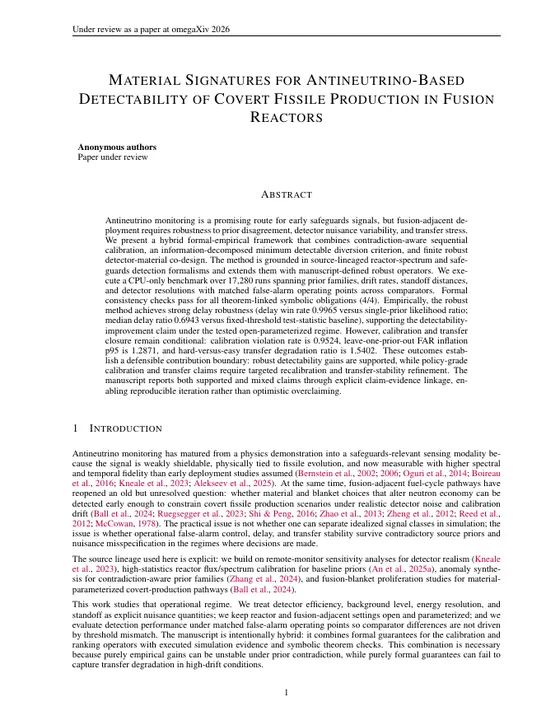
Antineutrino monitoring is a promising route for early safeguards signals, but fusion-adjacent deployment requires robustness to prior disagreement, detector nuisance variability, and transfer stress. We present a hybrid formal-empirical framework that combines contradiction-aware sequential calibration, an information-decomposed minimum detectable diversion criterion, and finite robust detector-material co-design. The method is grounded in source-lineaged reactor-spectrum and safeguards detection formalisms and extends them with manuscript-defined robust operators. We execute a CPU-only benchmark over 17,280 runs spanning prior families, drift rates, standoff distances, and detector resolutions with matched false-alarm operating points across comparators. Formal consistency checks pass for all theorem-linked symbolic obligations (4/4). Empirically, the robust method achieves strong delay robustness (delay win rate 0.9965 versus single-prior likelihood ratio; median delay ratio 0.6943 versus fixed-threshold test-statistic baseline), supporting the detectability-improvement claim under the tested open-parameterized regime. However, calibration and transfer closure remain conditional: calibration violation rate is 0.9524, leave-one-prior-out FAR inflation p95 is 1.2871, and hard-versus-easy transfer degradation ratio is 1.5402. These outcomes establish a defensible contribution boundary: robust detectability gains are supported, while policy-grade calibration and transfer claims require targeted recalibration and transfer-stability refinement. The manuscript reports both supported and mixed claims through explicit claim-evidence linkage, enabling reproducible iteration rather than optimistic overclaiming.
Cite this paper
@techreport{anon2026material4523fc66,
  title         = {Material Signatures for {Antineutrino-Based} Detectability of Covert Fissile Production in Fusion Reactors},
  institution   = {dinu.at},
  howpublished  = {Published at https://www.dinu.at},
  year          = {2026},
  date          = {2026-03-28},
  pagetotal     = {17},
  url           = {https://www.dinu.at/research/run-4523fc66-405b-43c6-bf72-6a6a90d22640},
}
Material Signatures for Antineutrino-Based Detectability of Covert Fissile Production in Fusion Reactors. (2026, March 28). Published at https://www.dinu.at. 17 pages. https://www.dinu.at/research/run-4523fc66-405b-43c6-bf72-6a6a90d22640
TY  - RPRT
TI  - Material Signatures for Antineutrino-Based Detectability of Covert Fissile Production in Fusion Reactors
PB  - dinu.at
PY  - 2026
DA  - 2026/03/28/
SP  - 17
UR  - https://www.dinu.at/research/run-4523fc66-405b-43c6-bf72-6a6a90d22640
N1  - Published at https://www.dinu.at
ER  -
More machine generated
- Machine generated · 2026 A Contradiction-Aware Survey Framework for Multi-Objective Decision Support
- Machine generated · 2026 AutoTW-ASP: Automatic Low-Treewidth Encoding Synthesis and Backend Routing for Neurosymbolic ASP
- Machine generated · 2026 AutoTW-ASP: Automatic Low-Treewidth Rewrite Synthesis and Uncertainty-Aware Backend Routing for Exact Neurosymbolic ASP Training
- Machine generated · 2026 Benchmarking and Selecting State-of-the-Art Modern Fourier Transformation Methods