Research / Machine generated
Quantum Reservoir Computing Under Comparator Parity: Regime-Conditioned Advantage, Entanglement Effects, and Kernel-Null Boundaries
Published with an anonymised author line — the document prints Anonymous authors / Paper under review. It is reproduced here exactly as generated.
- Year
- 2026
- Length
- 18 pages
How to read this
Written end to end by an agent. Published unedited, as evidence of what the system produces. It has not been reviewed, and no claim in it has been checked by a person. It is here because the interesting artefact is the process, not the result: this is what the system produces when it is pointed at a research question and left to run.
Abstract
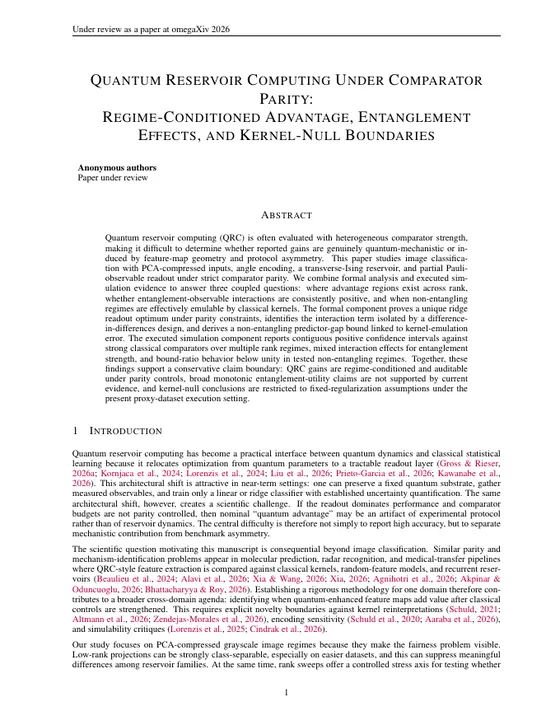
Quantum reservoir computing (QRC) is often evaluated with heterogeneous comparator strength, making it difficult to determine whether reported gains are genuinely quantum-mechanistic or induced by feature-map geometry and protocol asymmetry. This paper studies image classification with PCA-compressed inputs, angle encoding, a transverse-Ising reservoir, and partial Pauli-observable readout under strict comparator parity. We combine formal analysis and executed simulation evidence to answer three coupled questions: where advantage regions exist across rank, whether entanglement-observable interactions are consistently positive, and when non-entangling regimes are effectively emulable by classical kernels. The formal component proves a unique ridge readout optimum under parity constraints, identifies the interaction term isolated by a difference-in-differences design, and derives a non-entangling predictor-gap bound linked to kernel-emulation error. The executed simulation component reports contiguous positive confidence intervals against strong classical comparators over multiple rank regimes, mixed interaction effects for entanglement strength, and bound-ratio behavior below unity in tested non-entangling regimes. Together, these findings support a conservative claim boundary: QRC gains are regime-conditioned and auditable under parity controls, broad monotonic entanglement-utility claims are not supported by current evidence, and kernel-null conclusions are restricted to fixed-regularization assumptions under the present proxy-dataset execution setting.
Cite this paper
@techreport{anon2026quantum35ef89ea,
  title         = {Quantum Reservoir Computing Under Comparator Parity: {Regime-Conditioned} Advantage, Entanglement Effects, and {Kernel-Null} Boundaries},
  institution   = {dinu.at},
  howpublished  = {Published at https://www.dinu.at},
  year          = {2026},
  date          = {2026-03-26},
  pagetotal     = {18},
  url           = {https://www.dinu.at/research/run-35ef89ea-83d9-499a-8096-d47786947c65},
}
Quantum Reservoir Computing Under Comparator Parity: Regime-Conditioned Advantage, Entanglement Effects, and Kernel-Null Boundaries. (2026, March 26). Published at https://www.dinu.at. 18 pages. https://www.dinu.at/research/run-35ef89ea-83d9-499a-8096-d47786947c65
TY  - RPRT
TI  - Quantum Reservoir Computing Under Comparator Parity: Regime-Conditioned Advantage, Entanglement Effects, and Kernel-Null Boundaries
PB  - dinu.at
PY  - 2026
DA  - 2026/03/26/
SP  - 18
UR  - https://www.dinu.at/research/run-35ef89ea-83d9-499a-8096-d47786947c65
N1  - Published at https://www.dinu.at
ER  -
More machine generated
- Machine generated · 2026 A Contradiction-Aware Survey Framework for Multi-Objective Decision Support
- Machine generated · 2026 AutoTW-ASP: Automatic Low-Treewidth Encoding Synthesis and Backend Routing for Neurosymbolic ASP
- Machine generated · 2026 AutoTW-ASP: Automatic Low-Treewidth Rewrite Synthesis and Uncertainty-Aware Backend Routing for Exact Neurosymbolic ASP Training
- Machine generated · 2026 Benchmarking and Selecting State-of-the-Art Modern Fourier Transformation Methods